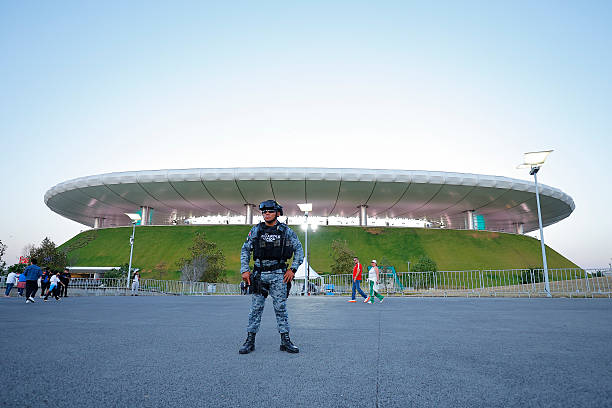
The 2026 FIFA World Cup was always going to feel different long before the first anthem echoes across a packed stadium in Mexico City or a late-night knockout game unfolds beneath the lights in New Jersey. This is the largest World Cup ever staged, stretched across three countries, sixteen host cities, and more than one hundred matches, carrying the weight of global attention across North America for more than a month. The scale alone changes everything, especially security.
For supporters travelling from Lagos, London, Buenos Aires, Seoul, Casablanca, or Berlin, the modern matchday experience will begin long before the referee blows the opening whistle.
It starts at the perimeter gates, beneath cameras, scanners, metal detectors, credential checks, and security teams operating with the precision of an international airport during peak holiday season. FIFA and local authorities understand the reality of hosting an event that will pull millions of people into stadium districts every single day, and their response has been a security operation built around control, visibility, and speed.
The result is a strict stadium code of conduct that leaves very little room for improvisation.
The days of arriving with oversized backpacks, bulky cameras, giant flags, glass bottles, or random personal items stuffed into a tote bag are effectively over. Every object entering the stadium environment now falls under layers of regulation designed to reduce delays, eliminate risk, and keep movement flowing through venues that may hold more than eighty thousand supporters at a time.
For many fans, especially those attending a World Cup in North America for the first time, the biggest surprise will not be the size of the stadiums or the intensity of the crowds. It will be how tightly controlled the environment feels from the moment they approach the venue.
- World Cup Security Experience
- The Clear Bag Rule
- Cameras, Drones, and the Line Between Fans and Media
- Power Banks, Batteries, and Electronic Restrictions
- Flags, Banners, and the Controlled Atmosphere of Modern Football
- Food and Drink Restrictions Inside Stadiums
- Weapons, Sharp Objects, and Everyday Items That Become Problems
- Noisemakers and the Battle Over Stadium Atmosphere
- Service Animals and Accessibility Regulations
- Powder Restrictions and Suspicious Materials
- Arrival Timing and the Airport Mentality
- The Emotional Trade-Off Behind Every Rule
World Cup Security Experience

International football culture has always carried an element of chaos that supporters secretly enjoy. Street vendors outside the gates, drums echoing through subway stations, giant flags draped over shoulders, flares glowing in distant corners, and crowds moving together like tides toward the stadium all form part of the mythology of major tournaments.
The 2026 World Cup still wants the spectacle. FIFA still wants the songs, the colours, the painted faces, and the emotion pouring from every section of every venue. What it no longer wants is unpredictability.
Security planning for this tournament began years before qualification campaigns even finished. Authorities across the United States, Canada, and Mexico coordinated policies around surveillance systems, crowd management technology, drone restrictions, emergency response procedures, and prohibited item enforcement.
Stadiums were redesigned not only to host football matches, but to process enormous volumes of people as quickly as possible without allowing blind spots or unnecessary congestion.
Supporters will notice that many stadiums now operate with multiple security rings rather than one central gate. Your first interaction with security may happen several hundred meters away from the stadium itself, where officials begin screening tickets, inspecting bags, and separating crowds into designated lanes before they even reach the outer concourse.
That layered structure exists for a reason. Organisers know that the greatest danger to large sporting events often comes from bottlenecks, confusion, or delayed crowd movement rather than from the match itself. The fewer problematic items people bring into the queue, the faster everyone moves.
This explains why the list of banned items has become so extensive.
The Clear Bag Rule
For international fans unfamiliar with North American sporting culture, the clear bag policy will likely feel unusually strict at first. It has already become standard practice across many NFL, MLS, NBA, and major entertainment venues over the last decade. FIFA has now adopted that system almost entirely for the World Cup.
Any bag entering the stadium must be transparent and fall within a very specific size limit of 12 inches by 6 inches by 12 inches. The bag can be made from clear plastic, vinyl, or PVC, but security personnel must be able to see its contents immediately without needing to conduct lengthy manual searches.
The philosophy behind the rule is brutally simple. Visibility speeds up entry.
A supporter carrying a transparent bag filled with permitted items can pass through inspection in seconds. A supporter arriving with a dark backpack packed with clothing, electronics, food, and miscellaneous objects creates delays that multiply across tens of thousands of people waiting behind them.
Traditional backpacks, travel bags, laptop carriers, duffel bags, and oversized purses will almost certainly be rejected at the perimeter. Even relatively small bags may be denied if security staff believe they violate size regulations or obstruct visibility.
There is one important exception. Fans are allowed to carry a small opaque clutch or wallet, provided it remains no larger than approximately 4.5 inches by 6.5 inches. That allowance exists largely for essentials like identification cards, payment methods, medication, or small personal items.
The rule sounds minor on paper until supporters realise how differently they must pack for a World Cup match compared to normal travel days. Large power adapters, extra clothing, toiletries, souvenirs, snacks, and unnecessary accessories quickly become liabilities rather than conveniences.
The most experienced tournament travellers often reduce their matchday essentials to four things only: phone, passport copy, payment card, and ticket.
Everything else becomes a potential delay.
Cameras, Drones, and the Line Between Fans and Media
Modern football culture exists through phones as much as through stadium seats. Every celebration becomes a vertical video within seconds. Every dramatic moment immediately lives on TikTok, Instagram, YouTube, and X before television broadcasts even finish replaying the incident.
FIFA understands this reality and has largely accepted casual fan recording as part of the atmosphere. Smartphones, compact digital cameras, and small personal devices remain permitted inside stadiums. Supporters will still capture songs, goals, celebrations, and emotional moments freely.
What FIFA does not want is unofficial professional production equipment spreading throughout the stands.
Dedicated cameras with detachable lenses longer than 10 centimetres are prohibited unless the owner possesses official media accreditation. Tripods, monopods, stabilisers, and selfie sticks are also banned due to safety concerns and crowd obstruction issues.
The selfie stick ban may sound excessive until you imagine eighty thousand supporters reacting simultaneously to a late winning goal while hundreds of metal rods swing through tightly packed rows. Stadium authorities increasingly classify those items as both obstruction hazards and potential weapons.
Drone regulations are even more severe.
The airspace surrounding every World Cup venue will operate under heavily restricted conditions coordinated alongside aviation authorities across all three host nations. Unauthorised drones flying near stadium districts can trigger immediate intervention from law enforcement, including confiscation, financial penalties, and possible criminal charges, depending on local regulations.
Security officials are particularly sensitive to drones because modern consumer models can carry recording equipment, interfere with operations, or create panic within large crowds. Even harmless recreational use near venues will receive almost zero tolerance.
Supporters hoping to create cinematic aerial footage of packed fan zones or dramatic stadium entrances should abandon the idea entirely.
Power Banks, Batteries, and Electronic Restrictions
One detail many travelling supporters overlook involves portable chargers and spare electronics.
World Cup days are long. Fans may spend hours navigating transportation systems, waiting through security queues, filming celebrations, checking maps, communicating with friends, and posting online continuously throughout the day. Dead phone batteries become genuine logistical problems in unfamiliar cities.
FIFA allows supporters to carry one portable power bank per person. The emphasis rests heavily on one.
Multiple battery packs, excessive charging equipment, or large collections of cables may attract additional inspection. Security teams increasingly view large quantities of electronic accessories as suspicious because they complicate screening procedures and create uncertainty around device classification.
Spare batteries are similarly restricted to minimal quantities. Most venues permit only one additional set.
These limitations partly reflect aviation-style security philosophy, where lithium battery management has become a growing concern globally. Stadium operators prefer simple rules because complicated technical assessments slow down entry lines dramatically.
Supporters planning full-day match experiences should therefore prioritise compact, efficient charging equipment rather than travelling with large electronic kits.
Flags, Banners, and the Controlled Atmosphere of Modern Football
World Cup imagery has always depended on giant flags waving through packed stands while drums and chants roll across entire stadiums. FIFA still encourages visual support, though within increasingly controlled boundaries.
Flags and banners remain allowed, though their dimensions are heavily regulated. The maximum permitted size generally sits around two meters by one and a half meters, preventing oversized displays from blocking sightlines or covering multiple seating sections.
Pole regulations are even stricter.
Only lightweight, flexible, non-flammable plastic poles may enter stadiums, and even those must remain under one meter in length with limited thickness. Metal poles, wooden shafts, and rigid materials will almost certainly be confiscated immediately.
The concern extends beyond visibility. Security officials evaluate every long object according to its potential use during crowd disturbances, panic situations, or confrontations.
Yet the most controversial restrictions involve messaging itself.
FIFA has intensified enforcement against political, discriminatory, religious, or socially provocative displays. Any banner, shirt, flag, or visual message interpreted as inflammatory, divisive, or advocacy-based risks removal regardless of intent.
The organisation continues presenting the tournament as a politically neutral territory, even while football increasingly intersects with global social tensions. Security personnel receive broad authority to determine whether content violates stadium conduct policies.
Commercial branding also faces heavy scrutiny.
Supporters wearing unofficial promotional material or carrying banners displaying non-sponsored corporate logos may be asked to cover or remove those items entirely. FIFA fiercely protects sponsor exclusivity during major tournaments, especially one expected to generate unprecedented commercial revenue.
For many supporters, the result feels like a carefully managed version of football culture rather than the unpredictable rawness associated with older tournaments. The noise remains. The colors remain. Nearly every visual element now exists within monitored limits.
Food and Drink Restrictions Inside Stadiums
One of the most frustrating realities for travelling fans involves food and beverage policies.
Outside of a few limited exceptions, spectators cannot bring outside food or drinks into World Cup stadiums. That includes sealed water bottles, takeaway meals, snacks, cans, glass containers, and most beverages purchased elsewhere.
From a security perspective, liquids create inspection challenges while outside food complicates venue operations and commercial agreements. From a supporter perspective, it means preparing for long stadium days entirely around internal concessions and refill stations.
There are exceptions, though they remain tightly controlled.
Parents travelling with infants may carry baby formula, milk, and sterilised water. Supporters with medical conditions requiring specific dietary items or medications may also receive permission, though documentation will likely be necessary. Medical liquids usually remain subject to quantity limitations, commonly capped at around 500ml depending on venue policy.
One increasingly common allowance involves empty reusable plastic water bottles. Many stadiums now provide refill stations inside the venue, allowing supporters to remain hydrated without bringing external liquids through security.
The key detail is material.
Glass and metal containers remain prohibited almost universally because they present obvious safety risks inside dense crowds. Disposable plastic beverage bottles may also face rejection depending on local implementation rules.
Fans attending summer matches in cities like Dallas, Houston, Atlanta, Monterrey, or Mexico City should take hydration planning seriously. Tournament days involving extreme temperatures, long transit journeys, and crowded conditions can become physically draining quickly.
Arriving early while carrying as little unnecessary material as possible often becomes the smartest strategy.
Weapons, Sharp Objects, and Everyday Items That Become Problems
Some prohibited categories feel obvious immediately.
Firearms, knives, explosives, fireworks, smoke bombs, flares, and chemical sprays all fall under automatic bans with severe consequences attached. Attempting to enter a World Cup venue carrying such items can lead not only to expulsion, but to arrest and criminal prosecution.
Yet many supporters become caught up in ordinary everyday objects they never considered problematic.
Small scissors buried inside backpacks, multitools attached to keychains, work tools forgotten after travel days, aerosol deodorants, metal water bottles, heavy flashlights, and pocket utility devices frequently trigger confiscation during stadium screening.
Security personnel evaluate objects according to potential use rather than intended purpose.
A seemingly harmless object becomes prohibited if authorities believe it could injure someone, disrupt crowd movement, or create panic during emergencies.
Umbrellas create another surprisingly contentious category.
Some stadiums allow small collapsible umbrellas depending on weather conditions, while others ban them entirely because they obstruct views and create movement hazards inside packed seating sections. Fans traveling during rainy conditions should check venue-specific guidance carefully rather than assuming universal consistency across all host cities.
Motorcycle helmets, hard-shell coolers, sporting equipment, frisbees, inflatable balls, and bulky personal items also remain prohibited due to size and obstruction concerns.
The underlying principle remains consistent throughout every rule.
If an item slows security operations, blocks visibility, risks injury, or complicates crowd control, it probably will not enter the stadium.
Noisemakers and the Battle Over Stadium Atmosphere
Football crowds naturally produce noise without assistance. Still, many supporters enjoy bringing instruments and noisemakers that amplify atmosphere throughout tournaments.
The 2026 World Cup sharply limits many of those traditions.
Whistles, air horns, loudspeakers, and certain amplified sound devices remain prohibited across most venues. Vuvuzelas, forever linked to the 2010 World Cup in South Africa, may also face restrictions depending on local stadium implementation.
Drums exist within a separate category.
Some organized supporter groups may receive pre-approved permission for percussion instruments, though those approvals generally require advance coordination with tournament organizers well before matchday. Random supporters arriving with large drums at security checkpoints should not expect spontaneous approval.
FIFA wants atmosphere, though controlled atmosphere.
Authorities increasingly prioritize communication clarity during emergencies, evacuation procedures, and crowd management operations. Excessively loud artificial noisemakers interfere with announcements and coordination systems inside large venues.
For traditional football supporters raised on organic terrace culture, some of these regulations may feel sterile compared to older tournaments where spontaneity defined the environment. Tournament organizers continue valuing predictability above nearly everything else.
Service Animals and Accessibility Regulations
Animals remain prohibited inside World Cup stadiums with one major exception involving certified service animals.
Supporters requiring assistance dogs must comply with local legal requirements within the host country, including documentation standards and health regulations where applicable.
Because the tournament spans three nations with differing accessibility laws and import procedures, travelers relying on service animals should begin preparations months before departure rather than assuming identical policies everywhere.
Stadium accessibility infrastructure across North America has improved dramatically over recent years, particularly in newer venues designed with modern mobility and assistance standards. Yet international travel logistics involving animals remain complex even under ideal conditions.
Early coordination becomes essential.
Powder Restrictions and Suspicious Materials
One lesser-known category involves powdered substances.
Large quantities of powders such as flour, sand, chalk, or unidentified granular materials often trigger additional inspection or outright confiscation. The policy reflects broader global security trends surrounding suspicious substances in crowded public environments.
Small cosmetic products like compact powder, makeup kits, or basic toiletries generally remain acceptable within personal-use quantities. The issue arises when security teams encounter larger volumes without obvious explanation.
Supporters attending matches directly after extended travel days should therefore review luggage carefully before approaching stadium checkpoints.
The fastest way through security often involves carrying almost nothing beyond verified essentials.
Arrival Timing and the Airport Mentality
Perhaps the most important adjustment for supporters involves timing expectations.
World Cup organizers strongly recommend arriving at stadium districts at least three hours before kickoff, especially for high-profile fixtures expected to attract maximum attendance.
That recommendation sounds excessive until supporters experience the scale firsthand.
Modern stadium security resembles airport processing more than traditional football entry. Multiple checkpoints, ticket verification systems, bag inspections, metal detectors, biometric technologies, crowd segmentation barriers, and transportation bottlenecks combine into a carefully choreographed movement operation.
Supporters who arrive late while carrying prohibited items risk missing substantial portions of matches simply attempting to resolve issues outside the perimeter.
Compounding the problem, many stadiums establish security zones far away from parking areas or transportation hubs. Being rejected at an outer checkpoint may require long walks back toward storage facilities, vehicles, or disposal locations before rejoining entry lines again.
The emotional cost matters too.
World Cup matchdays already carry enormous tension and excitement. Nothing drains energy faster than panicked arguments with security staff while thousands of supporters stream past toward the gates.
Veteran tournament travellers increasingly adopt one philosophy above everything else.
Travel light. Arrive early. Expect delays.
That approach rarely fails.
The Emotional Trade-Off Behind Every Rule
Football has always balanced freedom and control uneasily.
Supporters want emotional release, spontaneous celebration, visual chaos, and collective identity pouring through every section of the stadium. Tournament organizers want safety, order, sponsor visibility, operational efficiency, and controlled risk environments.
The 2026 World Cup leans heavily toward the latter.
That does not mean the atmosphere will disappear. The sound of eighty thousand people erupting after a decisive goal still shakes concrete regardless of security policies. National colors will still flood the streets. Chants will still echo through subway tunnels at midnight. Fans will still travel across oceans carrying stories, hopes, and lifelong memories into each stadium.
Yet the experience surrounding those moments has undeniably changed.
The modern World Cup supporter operates inside carefully designed systems built to eliminate unpredictability wherever possible. Every bag dimension, bottle restriction, flag measurement, and entry protocol reflects that philosophy.
For some fans, especially older supporters who remember looser tournament environments from previous decades, the shift may feel clinical. For others, particularly younger travelers raised within airport-style event security, the process may simply feel normal.
Either way, understanding the rules before arriving matters enormously.
A supporter carrying prohibited items will not receive special treatment because they traveled thousands of miles. Stadium security staff operate according to standardized procedures, often with little discretion once a violation appears.
Preparation becomes part of the World Cup experience itself.
You Might Also Want To Read This
- Top 10 Best Strikers (Centre-Forward) In The World 2024
- Top 10 Goalkeepers In The World 2024
- Top 10 Right Wingers In The World 2024
- Top 10 Best Left Back In The World 2024
- Top 10 Best Right Back In The World 2024
- Top 10 Attacking Midfielders In The World 2024
- Top 10 Defensive Midfielders In The World 2024
- Leeds United’s 10 Greatest Players Of All Time
- Aston Villa’s 10 Greatest Players Of All Time
- 8 Football Clubs That Have Suffered Deep Decline
- The Number 10 In Soccer – Why It’s So Special
- 10 Of The Greatest Danish Players Of All Time
- 10 Of The Greatest Irish Soccer Players Of All Time